

The Hungarian-American artist Maya Pearl Böröcz Silverberg is treating craft and fine art as permeable, contested spaces, moving between traditions and trespassing across disciplines. As we sat down for an interview with the artist in her London studio, the news of her selection for the 2025 cohort of New Contemporaries just came in.
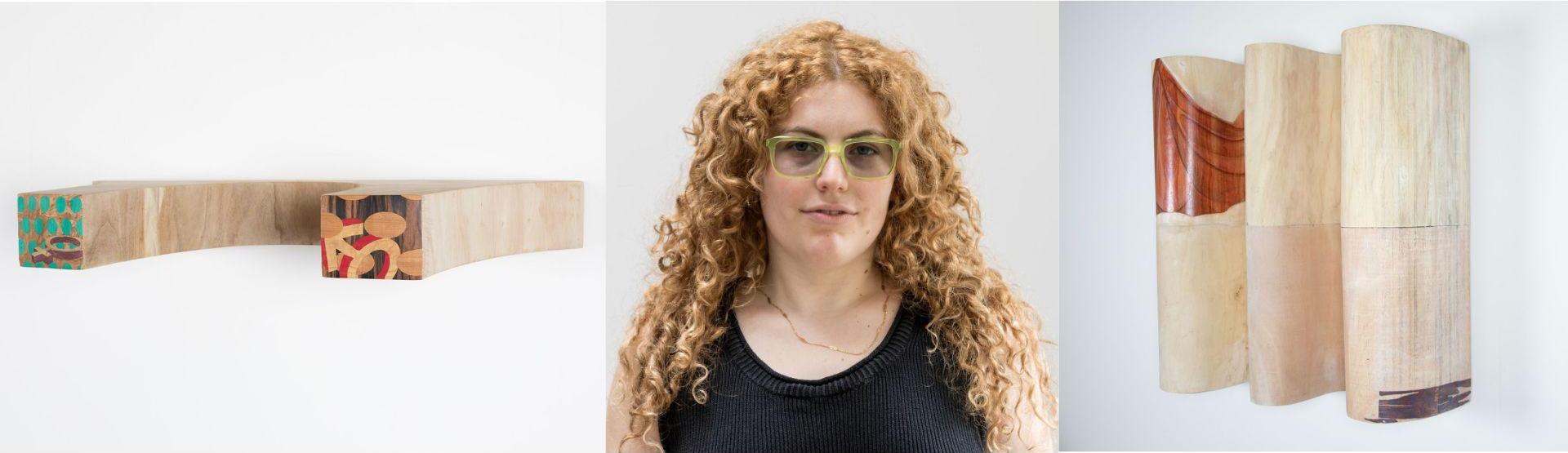
Horseshoe Theory, 2025, various wood veneers on plywood; Last Column of the Morning, 2025, plywood, oil paint, veneer, screenprint
First of all, congratulations. Being selected for New Contemporaries is a major moment. What does this mean to you at this stage in your career?
It’s an incredible honour to be included in a show with such a rich history. So many artists I admire—from friends to historical figures—have participated in New Contemporaries. I moved to the UK just over two years ago, so this feels like an incredibly warm welcome.
Take me back a bit - how did you first find your way into art?
I was born into a family of artists [her parents are the New York-based András Böröcz and Robbin Silverberg] and grew up both surrounded by art and engaged in making it. I decided to become a painter as a young adolescent; I clearly remember making the decision at age fourteen and feeling an exquisite sense of clarity about what I would do with my life.
Over the years, particularly since moving to London, I have moved in an increasingly sculptural and multimedia direction; much of my work doesn’t physically incorporate painting. But I continue to approach artistic questions from a painterly perspective, engaged with surface and patina.
Your practice is visibly expansive, but also very intentional. How would you describe what you’re exploring right now?
I produce multimedia artworks that investigate the nature of ornament, asking what is decorative and what is the nature of the relationship between the fine and decorative arts. I first entered this topic through the experience of training intensely in traditional decorative painting techniques in Brussels at the Van der Kelen Institute. I sought this experience out directly after graduating for my BA, because I was interested in actually participating in a craft tradition rather than simply referencing it.
I use some of the techniques that I learned directly in my artwork, but more than that it was the experience of entering a different paradigm of art-making, and a completely distinct world—the world of craft—that has constituted to the central paradigm of my subsequent work. I'm interested in being an interloper into these other worlds of making, and borrowing (or stealing) their techniques, aesthetics, and hierarchies.
My work incorporates oil painting, wooden sculpture, screen printing, collage, and photography. I use found and sourced materials, such as leather offcuts from the saddlery industry. Recent experiments include boulle marquetry and making designs using nails.
You’ve spoken before about coming from a Hungarian-American background. Tell us a little about your roots, how has that dual heritage shaped you?
I’m troubled by the concept of identity, which I feel is dominating the zeitgeist with disastrous results. However, yes, my father is Hungarian, and I’m a Hungarian citizen—a Jewish Hungarian—who was raised in Brooklyn. I strongly relate to a clichéd bicultural experience of feeling in between two cultures, and I think that sense of ambivalence, in the sense of having two forces or influences, as well as the experience of illegibility or illiteracy that I felt in Hungary has been formative to my artistic practice. My parents are both visual artists, so my work is automatically, I think, in conversation with theirs. There is a family dialogue that I am inextricably part of, and my work is strongly influenced by their artistic values: craftsmanship, the handmade. And from my father, a very particular sense of humour.
You’ve studied in New York and London, and spent time training as a trompe l'œil painter in Brussels. It’s an unusual, almost peripatetic educational path. Why did you choose that trajectory?
I studied art history and visual art at Columbia University for my BA, and recently graduated from the Slade School of Fine Art, UCL, with an MA in Fine Art. In between, I attended a traditional decorative painting technical institution, the Van der Kelen Institute, where I trained in nineteenth-century decorative painting techniques. At the time, as a painter I was interested in learning a different way of using and relating to paint, one that was not artistic. The Van der Kelen school allowed me to enter into a completely different world: the world of craft, which had a unique set of hierarchies, techniques, and aesthetic values. I was there as an interloper, surrounded by aspiring decorators, I wanted to use the experience for my own ends. I occasionally use the techniques that I learned from that training, but frequently invoke the questions that it gave rise to: what is decoration, and what does it mean to be decorative? How should fine art understand and relate to craft? What does it mean to appropriate different ways of making—a process that I am unapologetically engaged in?
Your first solo show, at DOXA Budapest, was titled Horseshoe Theory. I’m curious how that concept entered your work.
Horseshoe Theory is a political science concept which postulates that the extreme right and the extreme left are more similar to each other than they are to the center. I built a plywood sculpture that in some ways visually references the shape of a horseshoe, decorated on each end with handmade marquetries depicting an ascendant male symbol and a recumbent female symbol, each with garish polkadots.
I was interested in referencing the pressure that artists face to espouse a particular politics, expressed aesthetically. With the exhibition I wanted to see what would happen if I took that metaphor literally by nominally making the show actually about horses—which of course it is not. Alongside that sculpture, Horseshoe Theory—which I displayed in the form of a life-size photograph that I had taken of it, hung on the wall using actual horseshoe nails—I produced an installation made of leather offcuts that I sourced from the British saddlery industry.
I am interested in offcuts because they present the possibility of forming an interpersonal relationship with craft or industry, one based on affect. Moreover they are precisely the inverse of industry needs, constituting the remainder of an economic process that is aesthetically manifested. Finally, in the gallery space, I played audio of horses walking on cobblestones.
I chose to center this exhibition at least in name around the horse to be in conversation with the Hungarian context, in which horses are such overdetermined national symbols. I thought this would be really funny to show in Hungary. I must add that I am not at all interested in horses; rather they present an extremely useful and expedient vehicle for discussing many of the topics that interest me and have a rich craft and material culture that I want to engage with.
The work of the 2025 cohort of New Contemporaries will be on view at South London Gallery from January through April 2026 before traveling to MIMA, Middlesbrough, where it will be on view through the summer.
Biography
Maya Silverberg is a multidisciplinary artist whose work investigates painting’s status as both fine and decorative art. Trained in traditional Trompe l’oeil painting, she works between image and object.
Exhibitions include Horseshoe Theory, DOXA Budapest, 2025, and Not a House but a Memory, Gallery Rosenfeld, London, 2025. Maya was awarded the Sarabande Foundation Slade MA Final Year Award and the Bartolomeu dos Santos memorial Award. She holds an MA from the Slade School of Fine Art, a BA from Columbia University, and a Decorative Painting Certificate from the Van der Kelen Institute.