

10 Treurenberg, 1000 Brussels
Traveling Exhibition of the Gross Arnold Gallery
Launched in December 2024 on the occasion of the 95th anniversary of the birth of Gross Arnold (1929–2015), our traveling exhibition presents themes from the artist’s oeuvre that span his entire life’s work. Starting with visual interpretations of his birthplace and garden, and of Torda and its surroundings, the exhibition gradually expands toward Hungarian landscapes, foreign cities, and finally imaginary regions.
The homeland—the parental home in the small, cement-dust-covered Transylvanian town of Torda, with the studio of his father, also a painter, inside it; his mother’s flower garden; the surrounding hilly landscapes; the Turda Gorge; the Aranyos Valley; the Körös region; Torockó; and memories of the roads of Segesvár—all accompanied Gross throughout his life. In the courtyard, the wooden frame of a swing erected by his father became a recurring, emblematic motif in several of his later works. “For me, Torda meant safety, protection, what my parents provided until I was seventeen,” he later stated.
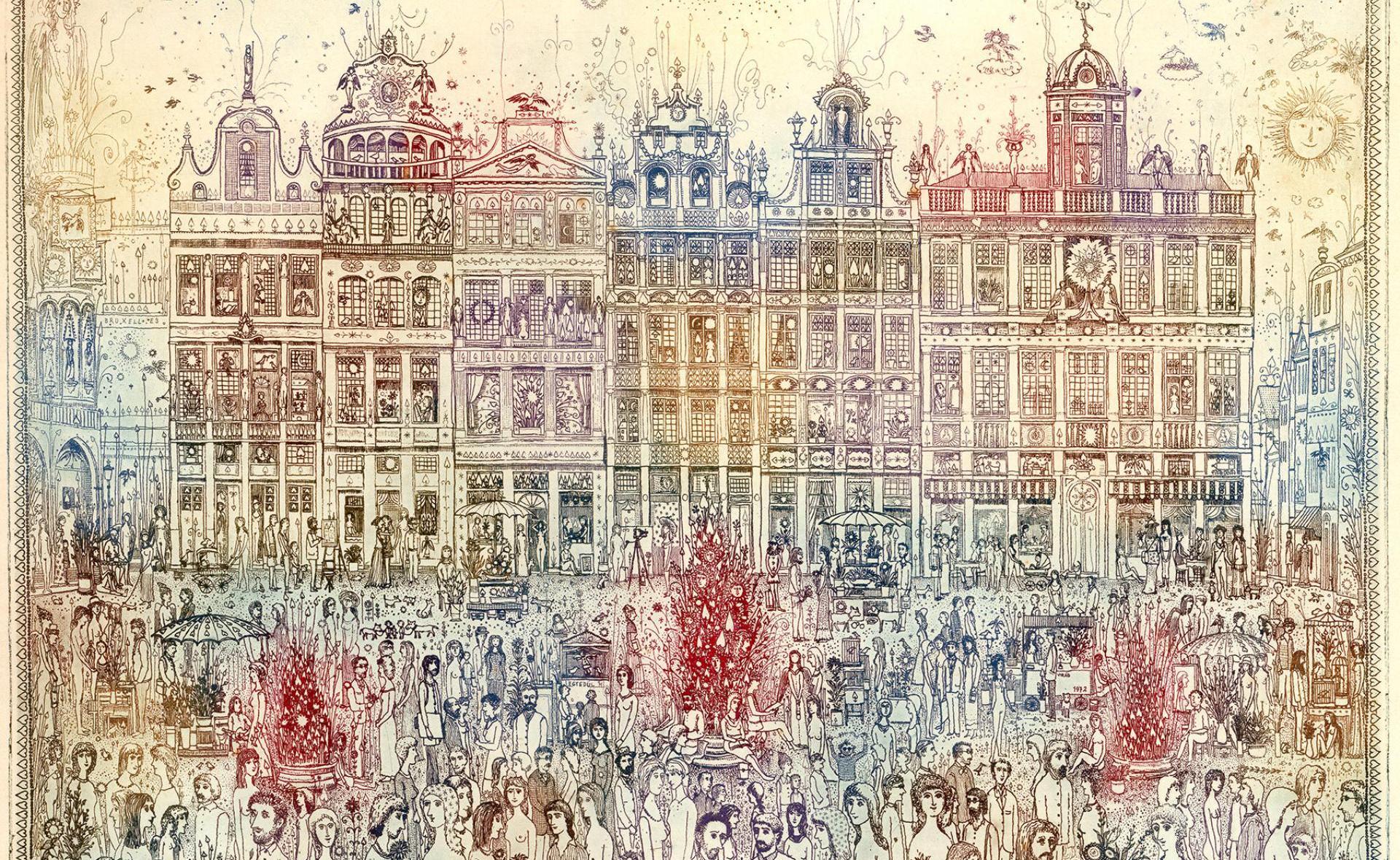
The majority of his works were created using the venerable intaglio technique of etching, which demands great technical mastery. His compositions are characterized by goldsmith-like refinement, with which he spreads his peculiar creatures across the picture surface like lace-like patterns. With his fairy-tale-like, deliberately naïve surrealism, he created an alternative fantasy world, opening ever new gates behind the surface of experiential reality. His childishly idyllic dream world is at times seasoned with humor, playfulness, and a touch of gentle irony.
The central theme of his art is art itself and the condition of being an artist. For Gross, this role provided the opportunity to step out of everyday reality. His fantasy world permeates natural landscapes just as much as urban scenes. All of this springs from an inner urge for longing and from the belief that the greyness of everyday life can always be overwritten by the joy of play and the elevation of celebration.
In his early self-portraits, Gross depicts himself drawing; later he appears rather in self-ironic, shape-shifting roles—as a bird in tails or as a goat longing after beautiful flower girls. Indirectly, however, he himself is the protagonist of every one of his images; each painter, each creative artist is an alter ego of Gross.
The studio and garden of the parental home in Torda take shape in Gross’s memory as a paradisiacal Eden, the undisturbed setting of the artistic creative work that meant his entire life (Tordai Studio, Garden of Memories). In this unique space, the creatures of mythical imagination and the machines of the modern technological world coexist peacefully, all brought to a common denominator by creative artistic imagination (Conversations on Friendship).
Alongside landscapes and the wonders of nature, urban space also occupied Gross from the very beginning. The subject of his early works is small-town idyll (Suburban Dream, Small-Town Dream), with its many strange yet lovable inhabitants. From this protected environment evoking his childhood years in Torda, he stepped out through his travels. First his imagination inhabited and rewrote Budapest (Budapest, the City of Blue Dreams). From the mid-1960s onward, he was already happily accompanying his foreign exhibitions in person.
The exhibition was selected from the gallery’s own archive by the artist’s son, the caretaker of the estate and director of the gallery, András Gross, on the occasion of the 10th anniversary of the Gross Arnold Gallery. The exhibition texts were edited by András Gross using studies by art historian Emese Révész, author of the monograph In the Garden of Art: Gross Arnold (1929–2015).